













How We Ranked the Top 20 AI Apps
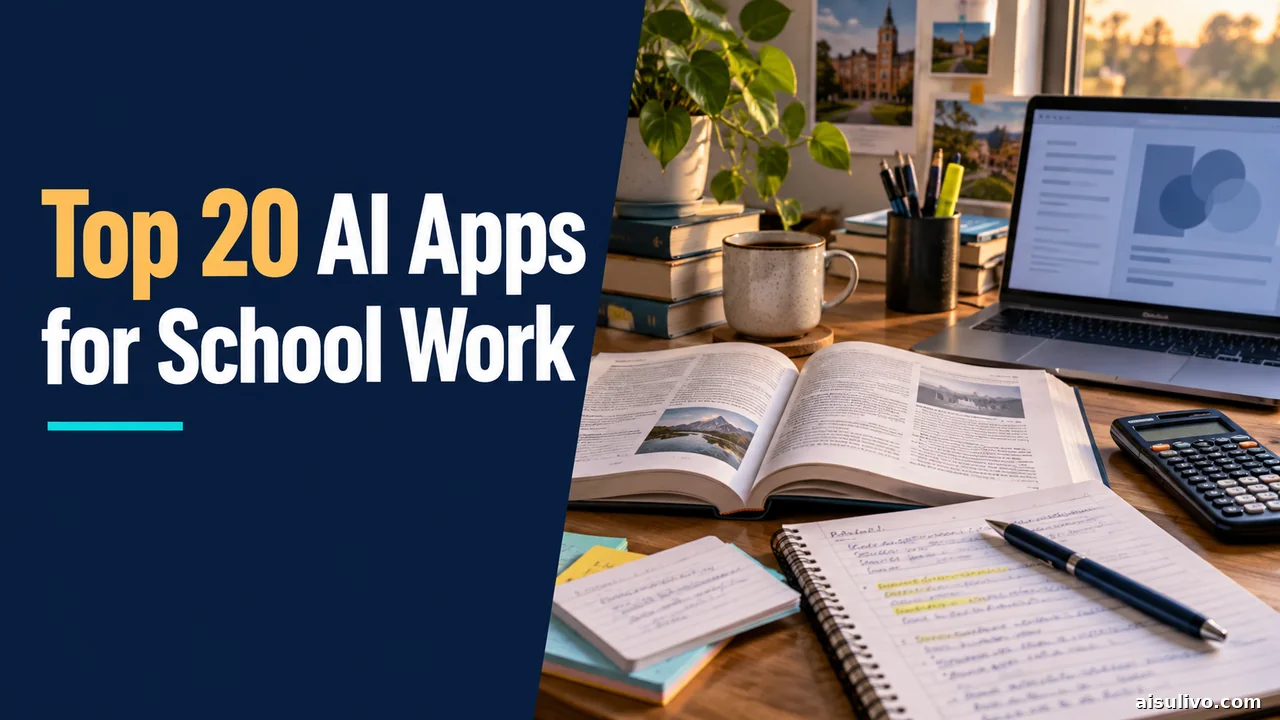
These Top 20 AI apps were ranked for helping students understand material and complete permitted parts of an assignment—not for producing work to submit unchanged. We weighted task fit, learning support, source traceability, feature depth, usability, platform coverage, value, integrations, privacy and rights, and verified availability. The order is editorial rather than a controlled benchmark, and displayed star ratings did not set it.
The list deliberately spans different jobs. General assistants lead because they can tutor across subjects, while source-grounded and academic-search tools rank highly for research. Writing, math, flashcard, presentation, transcription, and organization apps follow where a specialist workflow is more useful than another chatbot.
Use AI to Learn, Not to Outsource the Assignment

Begin with the instructor's rules. A safe workflow is to ask for explanations, examples, questions, feedback, or source discovery; do the reasoning and writing yourself; then verify every claim, calculation, quotation, and citation. If the course requires disclosure, record the tool, prompts, and how you used the output.
Do not use an app to impersonate your voice, fabricate references, solve a prohibited assessment, or hide copied work. If you cannot explain a submitted sentence or reproduce a mathematical step, the tool has probably done too much.
Compare the Top 20 AI Apps for School Work
| Rank | App | Best use | Access |
|---|---|---|---|
| 1 | ChatGPT | guided explanations, practice, and broad assignment support | Free Tier Available |
| 2 | NotebookLM | working from readings, notes, and approved source packs | Free Tier Available |
| 3 | Perplexity | finding current sources and starting a research trail | Free Plan Available |
| 4 | Claude | discussing long readings, arguments, and revision choices | Free Tier Available |
| 5 | Gemini | students already working in Google services | Free Tier Available |
| 6 | Consensus | finding peer-reviewed evidence for a focused question | Free Tier Available |
| 7 | Scite | checking how later papers cite a study | Trial / Paid Plans |
| 8 | ResearchRabbit | expanding a literature review from known papers | Free Plan Available |
| 9 | AskYourPDF | asking targeted questions about assigned documents | Free Access Available |
| 10 | NoteGPT | turning lectures and media into review material | Free Plan Available |
| 11 | Grammarly | editing clarity, tone, and mechanics in your own draft | Free Plan Available |
| 12 | QuillBot | careful rewriting and sentence-level revision | Free Plan Available |
| 13 | HyperWrite | brainstorming and revising non-assessed or permitted writing | Free Starter Access |
| 14 | Mathos | working through math problems with explanations | Free Access Available |
| 15 | Slay School | turning class material into active-recall practice | Free Plan Available |
| 16 | Gamma | building a first presentation structure from your own research | Free Plan Available |
| 17 | Canva | polishing presentations, posters, and project visuals | Free Plan Available |
| 18 | Notion | organizing classes, deadlines, sources, and group work | Free Plan + AI Trial |
| 19 | Otter AI | reviewing permitted lectures, meetings, and interviews | Free Plan Available |
| 20 | MagicSchool AI | educator-created supports, rubrics, and differentiated materials | Free Account Available |
Detailed Reviews in Ranking Order
Open each internal AiSulivo listing for a focused product overview. Plan names and limits change, so confirm current terms before uploading coursework or paying.
Why it ranks first
Study mode can ask questions, explain steps, use uploaded course material, and quiz understanding across many subjects.
Access and platforms
Free Tier Available; Web, iOS, Android, desktop.
Meaningful limitation
It can still make mistakes; verify facts and follow the assignment policy.
Why it ranks second
NotebookLM keeps answers tied to the sources you provide and can create summaries, study guides, questions, and audio overviews.
Access and platforms
Free Tier Available; Web, mobile apps.
Meaningful limitation
Its output is only as complete and reliable as the source set you upload.
Why it ranks third
Perplexity pairs web answers with links, making it useful for orientation, terminology, and finding material worth reading directly.
Access and platforms
Free Plan Available; Web, iOS, Android, desktop.
Meaningful limitation
A citation link is not proof the claim is supported; open and inspect every source.
Why it ranks fourth
Claude handles long documents and sustained discussion well, which helps with outlines, counterarguments, explanations, and feedback on a student-written draft.
Access and platforms
Free Tier Available; Web, iOS, Android, desktop.
Meaningful limitation
Do not let polished prose replace your own analysis or required disclosure.
Why it ranks fifth
Gemini supports brainstorming, explanations, summaries, and multimodal questions, with availability through personal and eligible school Google accounts.
Access and platforms
Free Tier Available; Web, iOS, Android.
Meaningful limitation
School-account features and data protections depend on the institution license.
Why it ranks sixth
Consensus searches scholarly literature and summarizes findings, helping students move from a broad claim toward papers they can evaluate.
Access and platforms
Free Tier Available; Web.
Meaningful limitation
Coverage and summaries do not replace reading methods, samples, and limitations.
Why it ranks seventh
Scite adds citation context such as supporting, contrasting, or mentioning relationships, useful when a paper looks authoritative but needs context.
Access and platforms
Trial / Paid Plans; Web, browser extension.
Meaningful limitation
Citation classifications are aids, not final judgments about research quality.
Why it ranks eighth
ResearchRabbit maps related authors and papers from seed references, making discovery more systematic than repeating broad keyword searches.
Access and platforms
Free Plan Available; Web.
Meaningful limitation
Its recommendations can reinforce a narrow starting set, so diversify databases and keywords.
Why it ranks ninth
AskYourPDF supports question-led reading of PDFs and document collections, useful for locating passages, comparing sections, and creating review prompts.
Access and platforms
Free Access Available; Web, mobile, browser extension.
Meaningful limitation
Check page context yourself and never cite a generated summary as the original source.
Why it ranks tenth
NoteGPT can summarize documents and media into notes, maps, flashcards, and other study formats for later active recall.
Access and platforms
Free Plan Available; Web.
Meaningful limitation
Summaries can omit qualifications, so keep the original lecture or reading beside them.
Why it ranks eleventh
Grammarly is strongest late in the workflow, when a student has written the argument and needs help spotting grammar, clarity, and tone issues.
Access and platforms
Free Plan Available; Web, browser, desktop, mobile.
Meaningful limitation
Accepting every rewrite can flatten voice or change meaning; review suggestions individually.
Why it ranks twelfth
QuillBot combines paraphrasing, grammar, summarizing, and citation utilities that can support revision and source handling.
Access and platforms
Free Plan Available; Web, extensions, desktop, mobile.
Meaningful limitation
Paraphrasing without attribution is still plagiarism; preserve meaning and cite the source.
Why it ranks thirteenth
HyperWrite offers drafting and research assistance across the browser, useful for planning, examples, and revisions when the course permits it.
Access and platforms
Free Starter Access; Web, browser extension.
Meaningful limitation
Its generated language needs fact-checking and should not be submitted as unacknowledged work.
Why it ranks fourteenth
Mathos focuses on mathematical problem solving and tutoring, making it more relevant than a general chatbot for equations and worked practice.
Access and platforms
Free Access Available; Web, mobile.
Meaningful limitation
Use hints and compare steps with course methods instead of copying a final result.
Why it ranks fifteenth
Slay School converts study material into flashcards and quizzes, helping students move from passive rereading to retrieval practice.
Access and platforms
Free Plan Available; Web, mobile.
Meaningful limitation
Generated questions may miss course emphasis or contain errors, so edit the deck.
Why it ranks sixteenth
Gamma can turn an outline into a visual presentation quickly, leaving more time to refine claims, sources, and speaking notes.
Access and platforms
Free Plan Available; Web.
Meaningful limitation
Generated slides can look finished before the evidence and narrative are ready.
Why it ranks seventeenth
Canva combines templates, presentations, graphics, and collaboration for students who need a clear visual deliverable rather than another text generator.
Access and platforms
Free Plan Available; Web, desktop, iOS, Android.
Meaningful limitation
Templates do not guarantee accessible contrast, accurate claims, or proper image rights.
Why it ranks eighteenth
Notion can keep assignment briefs, notes, tasks, databases, and project decisions in one workspace, with AI assistance available under plan limits.
Access and platforms
Free Plan + AI Trial; Web, desktop, iOS, Android.
Meaningful limitation
A complicated system can become procrastination; start with one course dashboard.
Why it ranks nineteenth
Otter records and transcribes conversations, creating searchable notes that can help with interviews, study groups, and lectures when recording is allowed.
Access and platforms
Free Plan Available; Web, iOS, Android.
Meaningful limitation
Get consent, follow school rules, and correct names, formulas, and quotations.
Why it ranks twentieth
MagicSchool is primarily educator-focused, but teacher-created scaffolds, rubrics, feedback aids, and student spaces can support schoolwork within a supervised workflow.
Access and platforms
Free Account Available; Web.
Meaningful limitation
Students should use it through teacher-approved activities rather than as an answer generator.
Choose a Small Student Tool Stack
Most students need three roles, not twenty subscriptions: one guided tutor, one research or source-grounded tool, and one specialist for the bottleneck that actually slows them down. That might be Grammarly for revision, Mathos for worked practice, Slay School for active recall, Gamma for slides, or Notion for deadlines.
- Reading-heavy course: NotebookLM plus Consensus or ResearchRabbit.
- Essay workflow: source discovery, your own outline and draft, then Grammarly or QuillBot for reviewed edits.
- STEM practice: a guided tutor plus Mathos, with every step checked against course methods.
- Group presentation: Notion for coordination and Canva or Gamma for the visual deliverable.
Privacy, Citations, and Academic Integrity

Never upload private student records, unpublished research, assessment keys, patient data, or another person's work unless the institution and tool terms permit it. Check retention, model-training controls, account age rules, and whether a school-managed version has different protections.
AI-generated citations can be nonexistent or mismatched. Open the paper, confirm the author, title, date, page, DOI or URL, and check that it supports the sentence. Paraphrasing still requires attribution. The student remains responsible for the final submission.
Frequently Asked Questions
What is the best AI app for college assignments?
ChatGPT is the broadest guided tutor here, while NotebookLM is stronger when answers must stay grounded in assigned readings. Research, math, writing, and presentation tasks may benefit from a specialist instead.
Can students use AI without cheating?
Yes, when the instructor permits it and the student uses AI for explanation, practice, planning, feedback, or source discovery while keeping the reasoning and submitted work their own. Follow the assignment-specific policy and disclose use when required.
Which tools help with academic sources?
Consensus, Scite, and ResearchRabbit focus on scholarly discovery or citation context. Perplexity can help find current web sources, and NotebookLM can analyze a source pack. Always read and cite the original source.
Are free AI apps enough for school work?
Often yes for occasional tutoring, search, revision, notes, or slides. Free plans usually have limits, and a paid plan does not make output more academically acceptable. Start with the smallest tool set that supports the permitted task.
A Responsible Submission Checklist
Before submitting, confirm the work answers the brief, the reasoning is yours, every source exists, quotations and paraphrases are attributed, calculations are reproducible, private data stayed protected, and any required AI disclosure is included. Use the Top 20 list as a menu of support—not a way to bypass learning.
Back to Top 20 AI appsAiSulivo publishes independent discovery and comparison information about third-party AI products. Features, limits, pricing, privacy, and education policies can change. Verify current official terms and follow your school, instructor, and assignment rules.