
NVIDIA PAIR Turns Idle Computers into a Local AI Team
The free beta spreads parallel agent requests across compatible machines, but it does not pool VRAM or split one model run.


NVIDIA Released the PAIR Beta
NVIDIA released the beta of Personal AI Router, or PAIR, on September 3. The free, open-source software distributes local AI inference requests across compatible computers on the same network. It is available for Windows, Linux and macOS and initially works with Ollama and LM Studio.
The simplest description is also the most important: PAIR is a router, not an inference engine and not a virtual super-GPU. An agent or application sends requests to one familiar local endpoint. PAIR checks which paired machine is ready, has the required engine and model, and is not too busy. It assigns the entire request to one eligible node, which runs the model and returns the response.
That distinction keeps the “personal AI cluster” label from creating the wrong expectation. Two computers with 16 GB graphics cards do not become one 32 GB device. PAIR does not pool memory, split one prompt across several GPUs or make a model fit on hardware that cannot hold it. Its advantage appears when a workload contains several independent requests that can run concurrently.
How NVIDIA PAIR Routes Local AI Requests
PAIR uses multicast DNS to discover nearby systems, with manual IP entry as a fallback. A person approves pairing before nodes communicate. NVIDIA says node-to-node traffic is protected with mutual TLS and generated certificates. The design keeps prompts, files and agent context on the existing local network, although internet access is still needed to download software and models.
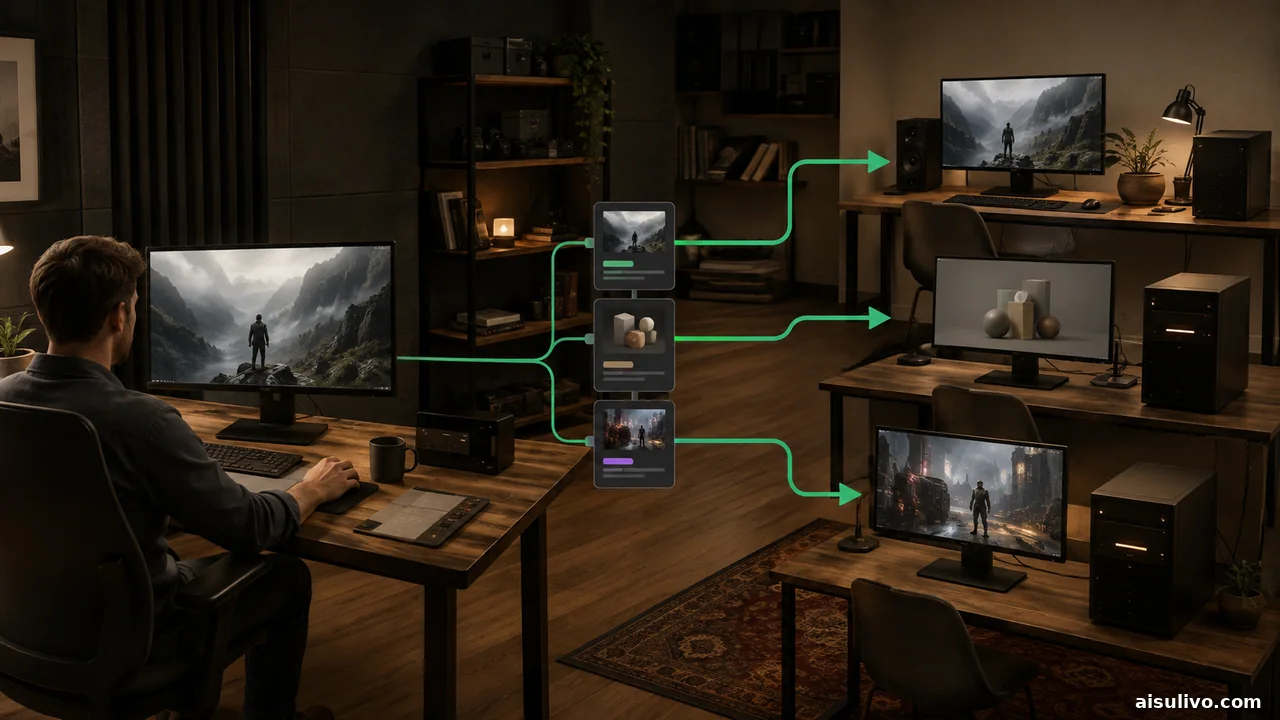
When a request arrives, the scheduler considers whether a node is online, whether its engine is enabled, whether the exact model is present, how much work is active and whether the GPU is occupied by a graphics-heavy application. A laptop can sleep; a gaming desktop can become busy; a workstation can rejoin later. PAIR is intended to adjust as availability changes.
The model executes from start to finish on the selected node. This is workload-level concurrency: several agent calls may run on several machines at once, but each call stays on one machine. The pattern fits agents that fan one assignment into research, coding, checking and synthesis tasks. Those calls otherwise queue when they all target one local engine.
PAIR Compatibility and Limits at Launch
The beta offers graphical and terminal interfaces. NVIDIA lists GeForce RTX 20-series and newer GPUs, RTX Pro workstation GPUs from the Turing generation onward, DGX Spark, and Apple systems with M4 or newer silicon among supported configurations. Each computer runs its own engine and stores its own model copy.
| Capability | PAIR beta | Important limit |
|---|---|---|
| App connection | One familiar local endpoint | Initially proxies Ollama and LM Studio |
| Work placement | Routes independent requests | One request remains on one node |
| Memory | Uses memory available per machine | Does not pool VRAM |
| Participation | Nodes can join or leave | Availability and speed can vary |
The proxy approach lets an existing agent harness keep using the interface it expects. PAIR handles placement behind that endpoint instead of requiring each application to adopt a new cluster API. The tradeoff is clear: simpler compatibility and elastic machines, but no model sharding or combined memory.
What NVIDIA’s PAIR Demonstration Shows
NVIDIA demonstrated a five-subagent workflow using Hermes Desktop, Ollama and Qwen 3.6 35B A3B. The company says the workload averaged 18 minutes on one RTX Spark laptop and 8 minutes 48 seconds on a three-device group containing that laptop, a DGX Spark and an RTX 5090.
Those figures show that routing can reduce queueing when a workload has enough parallel calls. They are not a universal benchmark. NVIDIA labels the demonstration unofficial and configuration-specific. Results change with model, request count, engine settings, network, node availability and machine speed. A mostly sequential job may gain little, while copying a model to every node adds storage and setup costs.
Telemetry matters too. Agent count is not routed-job count because one agent can generate several requests. Users should confirm in PAIR’s jobs view that work reached multiple nodes before crediting a faster run to distributed execution.
Who NVIDIA PAIR Is Really For
PAIR is most plausible for someone who already runs local models and owns at least two compatible systems: a work laptop and gaming desktop, or a workstation and DGX Spark. It may also suit a small studio seeking parallel internal inference without sending prompts to a cloud service. It will be less useful with one machine, one long sequential request or a model that exceeds every node’s memory.

The privacy pitch needs precise language. Local routing can keep inference traffic off a public cloud, but it does not automatically secure every device, model, application or file share. Users should update each node, restrict network access, review model licenses, protect endpoints and check that connected applications do not separately transmit data elsewhere.
Energy and noise are real costs. Idle computers consume electricity during sustained inference. A faster result may use more total power because several devices work simultaneously. The documentation does not establish a universal cost advantage over cloud APIs, especially when local and hosted models differ in quality.
What to Watch as the Beta Matures
The first tests are reliability and observability: discovery across common routers, clean node departures, predictable request recovery and understandable scheduling decisions. Engine coverage also matters. Ollama and LM Studio are useful starting points, but broader adoption depends on more backends, hardware combinations and agent frameworks.
Open-source availability lets developers inspect and improve discovery, pairing, routing and interfaces. It also enables verification of the privacy and security design described by NVIDIA. Beta status means bugs and breaking changes remain plausible, so PAIR belongs on noncritical workloads until users establish dependable behavior.
The product is narrower—and more useful—than the “AI data center at home” metaphor. NVIDIA PAIR does not merge a household’s graphics cards. It gives parallel local-AI requests a traffic controller that can send each job to a suitable machine. For multi-agent workflows on hardware people already own, that can turn idle capacity into shorter queues without redesigning the application.
NVIDIA PAIR FAQ
Does NVIDIA PAIR combine GPU memory?
No. Each complete request runs on one eligible machine, and the model must fit that machine’s memory. PAIR distributes separate requests rather than pooling VRAM.
Which apps and computers does PAIR support?
The beta proxies Ollama and LM Studio on Windows, Linux and macOS. NVIDIA lists recent GeForce RTX and RTX Pro systems, DGX Spark, and Apple M4-or-newer systems among validated hardware.
Does PAIR keep every AI workflow private?
PAIR is designed to keep routed inference on the local network, but overall privacy still depends on each device, model and connected application. Users must verify those components separately.
The bottom line: PAIR can shorten queues for parallel local-agent work across compatible machines. It cannot turn several GPUs into one larger GPU, and its beta claims need testing on each user’s real network.