

What Muse Glimmer is
Meta's Muse Glimmer is a ~30-billion-parameter open-weight model aimed at always-on agents you can run locally — on a Mac or PC with one solid consumer GPU. It is built for multi-step work: coding, function calling, reading documents and screenshots, recovering from failed tool calls, and evaluating other models — not just one-shot chat replies.
The weights ship under Apache 2.0, which is generous for use, modification, redistribution, and commercial products (subject to the license and the law). Meta calls this an open-weight release on purpose: you get the weights, not a claim that every training dataset and internal pipeline is fully open source.
Practical frame: Glimmer is not trying to replace every frontier cloud model. It is trying to put a capable multimodal agent on hardware small teams and advanced hobbyists already own — with ownership, offline options, and lower recurring token bills.
Sources: Meta AI Research announcement, Hugging Face model card, AMD technical blog, and Reuters coverage.
Muse Glimmer 30B quick specifications
| Specification | Official detail | Why it matters |
|---|---|---|
| Model size | ~29.6B parameters (incl. vision encoder) | Fits high-memory consumer setups when quantized |
| Architecture | Dense causal transformer + perception encoder | Language plus image understanding |
| Context length | 131,072+ tokens | Long docs, persistent agent context |
| I/O | Text + image in, text out | Screenshots, charts, documents |
| Languages | Training covers 100+ languages | Broad multilingual potential; quality varies |
| Knowledge cutoff | January 4, 2026 | Newer facts need retrieval |
| License | Apache 2.0 | Research, forks, and commercial use |
What makes Muse Glimmer an agentic model
A chatbot answers a prompt. An agent keeps a plan, calls tools, checks the result, recovers from errors, and continues until the job is done. Meta trained Glimmer around that longer loop.
| Capability | What it is designed to do | Example |
|---|---|---|
| End-to-end tasks | Carry a request through to a finished result | Fix a bug across several files |
| Reliable tool use | Call functions with structured schemas over long workflows | Query a DB, then draft a report |
| Multi-step reasoning | Keep a coherent plan over extended work | Compare and summarize many documents |
| Failure recovery | Diagnose failed tool calls and retry | Fix a bad command or missing resource |
| Multimodal reasoning | Mix text with screenshots, charts, and docs | Debug from a UI screenshot |
| Controllable effort | Low / medium / high / xhigh reasoning strength | Trade speed for depth |
How Meta trained Muse Glimmer
Meta says Glimmer pulls agentic reasoning from the larger Muse Spark teacher via distillation. Pre-training used Spark outputs with logit distillation. Mid-training leaned into longer-context and agent-heavy examples. Post-training mixed supervised fine-tuning, on-policy distillation, and reinforcement learning across general reasoning, coding, and agent tasks.
The bet is simple: keep the skills that matter for local agents, cut the memory and compute bill. A 30B model still will not match the largest frontier systems on every benchmark — and Meta is not pretending it does.
Local hardware and memory requirements
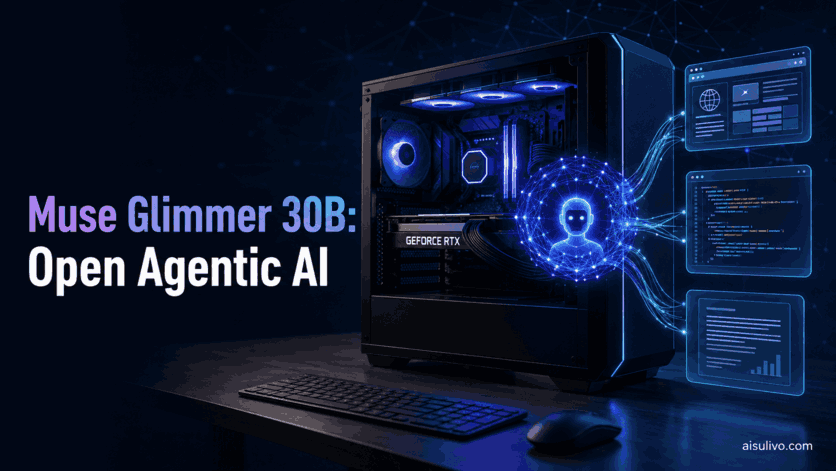
At full precision, Meta says a 30B model wants more than 55 GB of memory. Roughly 4-bit quantized builds drop language-model weights under 20 GB, but you still need headroom for the KV cache, perception encoder, and speculative-decoding drafter. That is why the practical target is a 24 GB or 32 GB envelope — not a thin laptop GPU.
| Version | Target hardware | Reported avg. degradation | Best fit |
|---|---|---|---|
| Full precision | 64 GB VRAM class | Baseline | Research, fine-tuning, max fidelity |
| K Quant Dynamic | 32 GB VRAM class | 0.2% | High-quality local inference |
| K Quant 17GB | 24 GB VRAM class | 1.0% | Single-GPU consumer deploy |
Degradation numbers are Meta-reported averages across 15 common benchmarks. Real quality and latency still depend on runtime, context length, quantization, and which tools you enable.
DFlash speculative decoding performance
Glimmer ships with a lightweight DFlash drafter: it proposes token blocks, the main model verifies them in parallel. Meta reports identical quality for accepted speculative tokens and faster generation under its test setup.
| Hardware | Baseline tok/s | With DFlash | Reported speedup |
|---|---|---|---|
| NVIDIA RTX 5090 | 74.9 | 233.4 | 3.1× |
| Apple M4 Max | 23.7 | 37.8 | 1.5× |
| Apple M5 Max | 26.6 | 50.2 | 1.8× |
Vendor numbers: batch size one, greedy decoding; Apple via ExecuTorch, RTX via llama.cpp. Useful reference points — not a guarantee on your machine.
Selected official benchmark results
Meta compared Glimmer with similarly sized Gemma4-31B and Qwen3.6-27B thinking setups. Scores swing by benchmark — no single number crowns a winner.
| Benchmark | Muse Glimmer 30B | Gemma4 31B | Qwen3.6 27B |
|---|---|---|---|
| MCP Atlas Public | 75.5 | 54.2 | 62.5 |
| DeepSearch QA | 74.6 | 61.7 | 71.1 |
| SWE Bench Pro | 51.2 | 36.9 | 50.2 |
| SWE Bench Verified | 76.0 | 66.6 | 77.2 |
| TerminalBench 2.1 | 51.7 | 43.4 | 60.7 |
| Charxiv Reasoning | 78.8 | 77.7 | 78.4 |
All figures above come from Meta's model card. Run your own evals before you pick a production stack.
Deployment options
- Local apps — routes include Ollama, LM Studio, and Unsloth.
- Edge runtimes — llama.cpp, ExecuTorch, and MLX for device-focused work.
- Scaled serving — vLLM and SGLang if you expose it as a server.
- Hosted providers — Meta lists Together AI, Fireworks AI, and OpenRouter among quick starts.
- Customization — fine-tune or adapt the released weights for specialized tasks.
Privacy, cost, safety, and limits
Local inference can keep files and prompts off a third-party cloud, cut token bills, and help offline workflows. It is not automatically private or safe. Agents can still touch sensitive files, credentials, networks, or external tools — so permissions, logging, storage, and sandboxing still matter.
Meta assessed Glimmer at Moderate or lower risk for chemical/biological, cyber, and loss-of-control categories under its framework. The model card still recommends app-level guardrails and human confirmation before irreversible actions. Known limits include inaccurate or biased answers, weaker multi-step performance on unfamiliar tasks, uneven language quality, and small quantization edge cases.
Glimmer accepts images but does not generate them, and it has no audio I/O. Video is not a first-class modality — it is treated as individual frames. The January 2026 cutoff means current events need retrieval.
Who should consider Muse Glimmer
| User | Why it may fit | Check first |
|---|---|---|
| Local AI developers | Open weights + broad runtime support | GPU / unified memory available |
| Privacy-sensitive teams | On-device processing can cut cloud exposure | App permissions and logging |
| Coding-agent builders | Tool use, coding, and recovery are core targets | Repo sandbox + command approval |
| Researchers | Apache 2.0 weights and fine-tuning support | Eval design and reproducibility |
| Low-memory laptop users | Limited fit | 24 / 32 GB target may be a barrier |
Frequently asked questions
Is Muse Glimmer fully open source?
The model weights are under Apache 2.0. "Open-weight" is the clearest label — not every piece of training data and the development pipeline is necessarily open.
Can Muse Glimmer run on one GPU?
Yes, on a suitable high-memory GPU. Meta targets 24 GB and 32 GB quantized configurations, not ordinary entry-level graphics cards.
Can it understand images?
Yes. It takes interleaved text and image input through a dedicated perception encoder and returns text.
Can businesses use it commercially?
Apache 2.0 generally allows commercial use, modification, and redistribution — subject to the license, applicable law, and how you deploy it responsibly.
Bottom line: Muse Glimmer puts a modern, agent-focused multimodal model into a hardware range advanced consumers and small teams can run locally. Its value is ownership, customization, offline operation, and potentially lower recurring cost — when a 30B local agent is capable enough for the job.
Back to top