
Google WeatherNext 3 Brings Hourly AI Forecasts to Maps
Google’s new model refreshes global forecasts hourly and sharpens key surface variables, while uncertainty and independent testing still matter.

Google Released WeatherNext 3
Google released WeatherNext 3 on September 3 and began integrating the AI weather model into Search, the Gemini app, Google Maps, Google Maps Platform’s Weather API and Google Earth Engine. The company says the system produces a global forecast every hour, ingests live satellite observations and resolves some surface variables on a grid as fine as five kilometers.
The practical change is a tighter connection between current observations and the forecast people see. WeatherNext 2 produced forecasts on a 25-kilometer grid at six-hour intervals. WeatherNext 3 can update hourly and provide five-kilometer output for near-surface temperature and moisture, 10-kilometer output for other surface variables and 25-kilometer output for atmospheric variables such as wind.
Finer pixels and more frequent updates do not make every local prediction correct. They can preserve geographic details that coarser global grids smooth away and respond sooner as cloud systems, fronts or surface conditions change. That is especially relevant near coastlines, valleys and mountains, where temperature and humidity can vary sharply across short distances.
WeatherNext 3 Learns From More Direct Observations
Many global AI weather systems learn heavily from numerical weather prediction analyses: physics-based, supercomputer-generated reconstructions of the atmosphere. Those datasets are valuable but arrive after processing and can smooth fast-moving conditions. Google says WeatherNext 3 supplements historical analysis with hourly geostationary-satellite mosaics and learns directly from sparse weather-station observations.
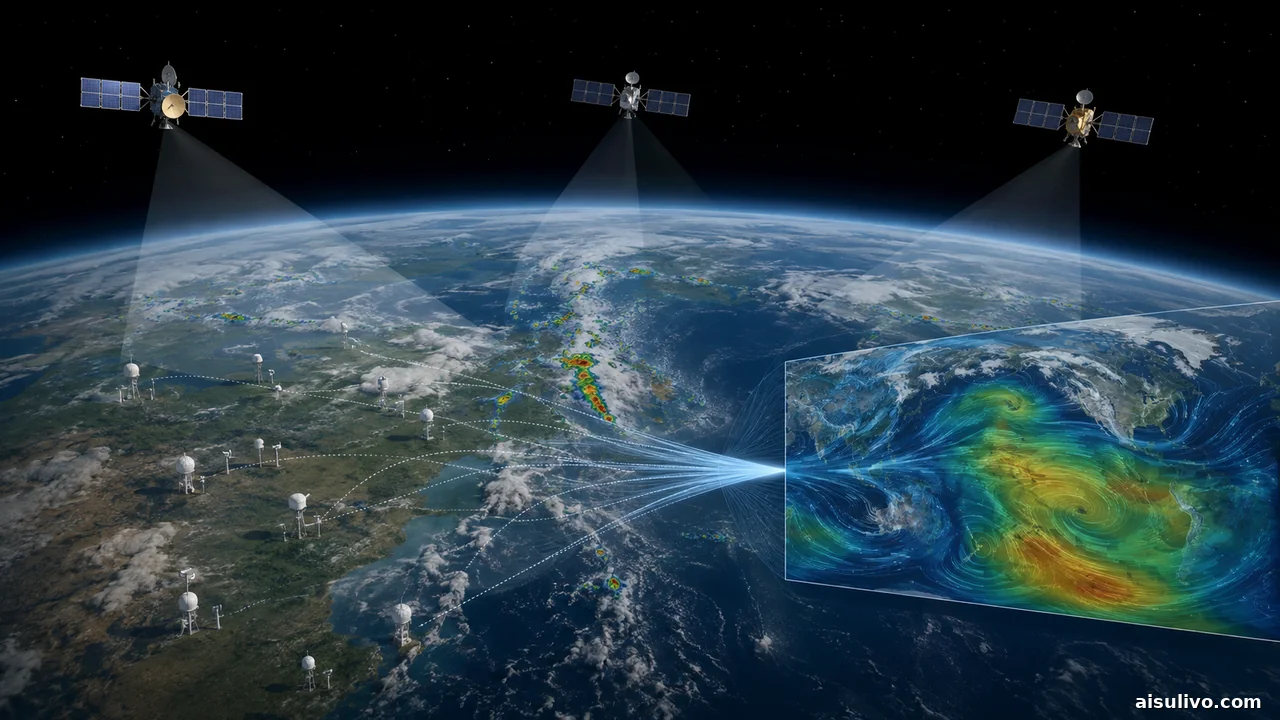
The architecture uses a Functional Generative Network mesh transformer. It produces dense gridded fields, cyclone tracks and predictions for specific station locations. Training against stations connects the model to measured conditions at real points rather than only to values averaged across a grid.
TechCrunch reported that the system is 2.4 times larger than its predecessor and uses specialized decoder targets. Size alone does not explain forecast skill. The consequential choices are the observational inputs, native station predictions, variable-specific resolution and ability to refresh every hour.
Google calls WeatherNext 3 its most advanced and accurate global weather model, citing live Brightband evaluations. That claim remains attributed because weather skill varies by variable, lead time, region and scoring rule. No single score makes one system best for every use.
WeatherNext 2 vs. WeatherNext 3
The model changes are easiest to understand as a set of exact mappings rather than one broad “more accurate” label.
| Forecast element | WeatherNext 2 | WeatherNext 3 |
|---|---|---|
| Update cycle | Six-hour intervals | Hourly forecasts |
| Core global grid | 25 kilometers | Up to 5 kilometers for key surface variables |
| Live observations | Primarily analysis inputs | Hourly satellite mosaics plus station targets |
| Product reach | Research and selected services | Search, Gemini, Maps, APIs and Earth Engine |
A five-kilometer grid is roughly five times finer in linear spacing than 25 kilometers, but it is not a street-level promise. The effective skill depends on input quality, terrain, variable and forecast horizon. A sharper map can still contain uncertainty and systematic error.
How to Read the Precipitation Accuracy Claims
Rain and snow remain difficult because clouds and precipitation develop at scales global models struggle to resolve. Google trained WeatherNext 3 using NASA’s Integrated Multi-satellite Retrievals for GPM data and a Google precipitation reanalysis based on satellite radar.
The company reports improvements in Continuous Ranked Probability Score of up to 60 percent against IMERG, 30 percent against the U.S. Multi-Radar/Multi-Sensor system and 10 percent against rain gauges at early lead times. CRPS compares a probabilistic forecast distribution with what occurred; lower error is better. Improvement against one reference dataset is not the same as saying every rain forecast is 60 percent more accurate.
For consumer products, Google uses another summary: when planning a day or more ahead, people may see precipitation forecasts that are up to 50 percent more accurate, with larger gains where predictions have historically been less reliable. “Up to” signals a best case, not a guaranteed uplift for every place and hour.
TechCrunch also identified a novelty dispute. Google describes WeatherNext 3 as the first high-resolution global AI forecast to incorporate raw observations directly, while startup WindBorne says WeatherMesh 6 has used raw observations since 2025. Google points to its global resolution. The disagreement shows that “first” depends on definitions. Both systems still rely on national weather datasets.
Where WeatherNext 3 Will Reach Users
WeatherNext 3 is beginning to power longer-range weather experiences in Google Search, Gemini and Maps. Developers and researchers can reach forecast data through Google Maps Platform’s Weather API, Google Earth Engine and Google Cloud. Google says the model is available globally, although product rollouts can differ by interface, region and account.
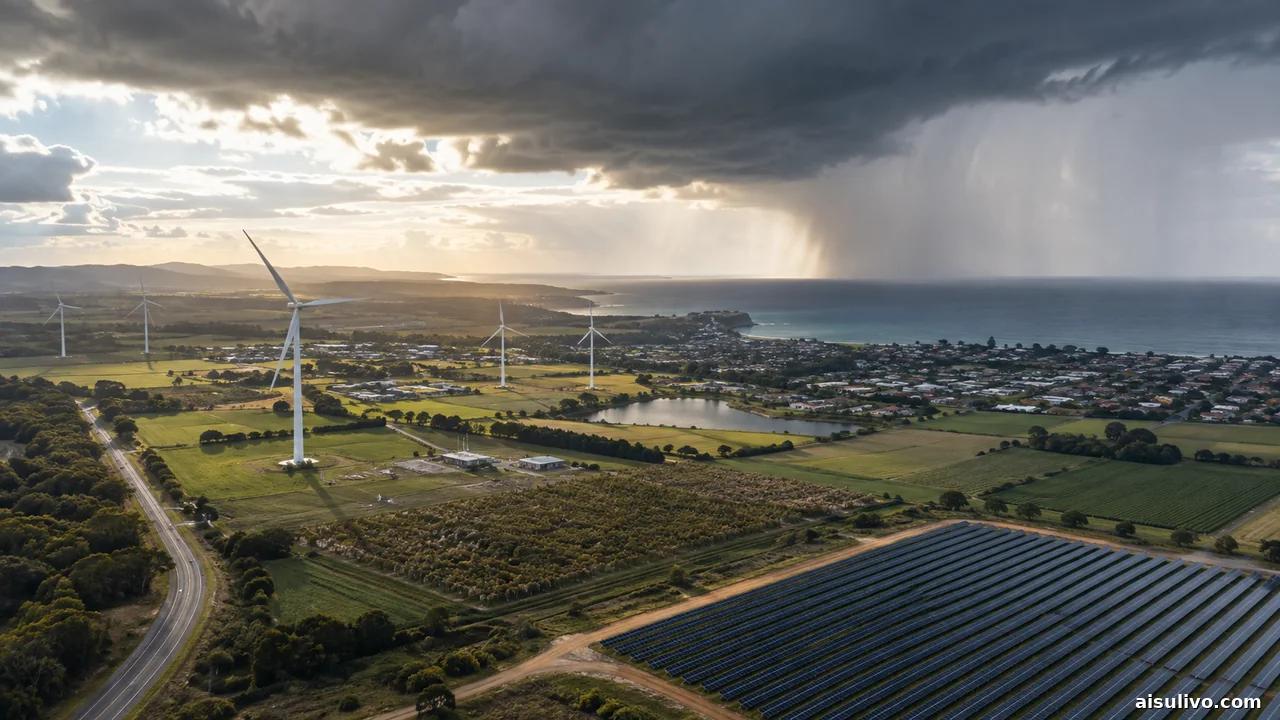
The model also forecasts variables for clean-energy planning. Wind predictions around turbine height, plus higher-resolution cloud cover and solar-radiation estimates, can help operators estimate renewable output. Farmers, logistics planners and emergency teams may benefit from more localized, frequently refreshed guidance, but consequential decisions should combine sources and professional judgment.
The useful comparison is not AI versus meteorologists. Weather services blend observations, physics-based forecasts, AI systems, ensembles and human expertise. AI models can generate predictions quickly after training, while physics models provide grounded simulations and mature operational practice. WeatherNext 3 adds a forecast stream; it does not make national warnings obsolete.
What Users and Developers Should Watch
Independent performance across seasons and regions is the central test. A global average can hide weaker results for rare extremes, small islands, complex terrain or places with sparse observations. Hourly output may look precise while uncertainty remains high. Users need probability, provenance and update-time information, not only a sharper map.
Presentation matters because Search and Maps can distribute output at enormous scale. A single rain icon can conceal several possible outcomes. API developers should examine variable definitions, lead times, coverage, service limits and fallback behavior before building operational systems around the model.
Satellite inputs improve freshness but do not directly measure every surface condition. Clouds obscure some observations, station networks remain uneven and severe local events can evolve below the grid’s effective resolution. Five kilometers is much finer than 25; it is still not a street-level guarantee.
WeatherNext 3 is best understood as a meaningful operational step: more direct observational inputs, hourly global updates, finer surface forecasts and immediate integration into widely used products. Its long-term value will rest on sustained independent evaluation and on whether people receive clearer forecasts without mistaking resolution for certainty.
Google WeatherNext 3 FAQ
How often does WeatherNext 3 update?
Google says it can produce a new global forecast every hour using recent satellite observations, compared with the six-hour cycle described for WeatherNext 2.
Is WeatherNext 3 accurate down to individual streets?
No. Some surface variables use a five-kilometer grid, which is finer than before but does not guarantee conditions at a particular street or building.
Does WeatherNext 3 replace official weather services?
No. National services combine observations, physics models, AI forecasts, ensembles and meteorologist judgment. People should continue following official alerts for consequential weather decisions.
The bottom line: WeatherNext 3 makes Google’s global AI forecasts more observational, frequent and detailed. The release is significant, but independent evaluation and clear uncertainty remain as important as resolution.